It took four shortages for science to notice helium
Fifty years of research on the second element: a field that drifted away from the gas it depends on, the supply work China took up out of need, and the chipmaking importers missing from both.
The element that exhibits the coolest phenomenon in fluid dynamics is quietly losing its researchers. Cooled to within two degrees of absolute zero, helium becomes a superfluid that flows without friction, creeps up the walls of its container and carries its rotation in quantized vortices, and for much of the twentieth century it was one of the great playgrounds of physics, yet the slice of helium research given to superfluid helium and helium-3 has halved, from 74 in every 1,000 helium papers in 2006–10 to 36 in 2021–25. That would be a curiosity in any other year, but this year roughly a third of the world's helium supply has been offline, and the gas that the physicists stopped studying has become one that chipmakers, hospitals and quantum-computing labs cannot get enough of.
The Long Slide
The fall of superfluid research is part of a much longer one, and our Research Intensity Score, which combines an element's share of research with how often that research is cited, shows helium rising through the 1950s and 1960s to a peak of 0.163 in 1973–75 and then falling in every single year since, fifty years without a pause, to 0.150 in 1980, 0.081 in 2000, 0.049 in 2010 and 0.020 in 2025, the lowest in the 126 years we score, so that it has lost seven-eighths of its place in science. The plainest count of the literature tells the same story, with helium's share of all element mentions peaking in 1971 at about 14 in every 1,000 and falling to 2.2, and the decline is more than other elements pulling ahead, because our Historical Research Intensity, which measures an element against its own record, has also fallen every year since 1975, from its peak of 0.99 in 1973 to 0.24 in 2025, which leaves helium with about a quarter of the place in science it held at its height and 45th of the 118 elements today. Far from levelling off, the fall is speeding up, with helium's score halving roughly every 28 years between 1975 and 1995, every 15 between 1995 and 2010, and every 12 since.
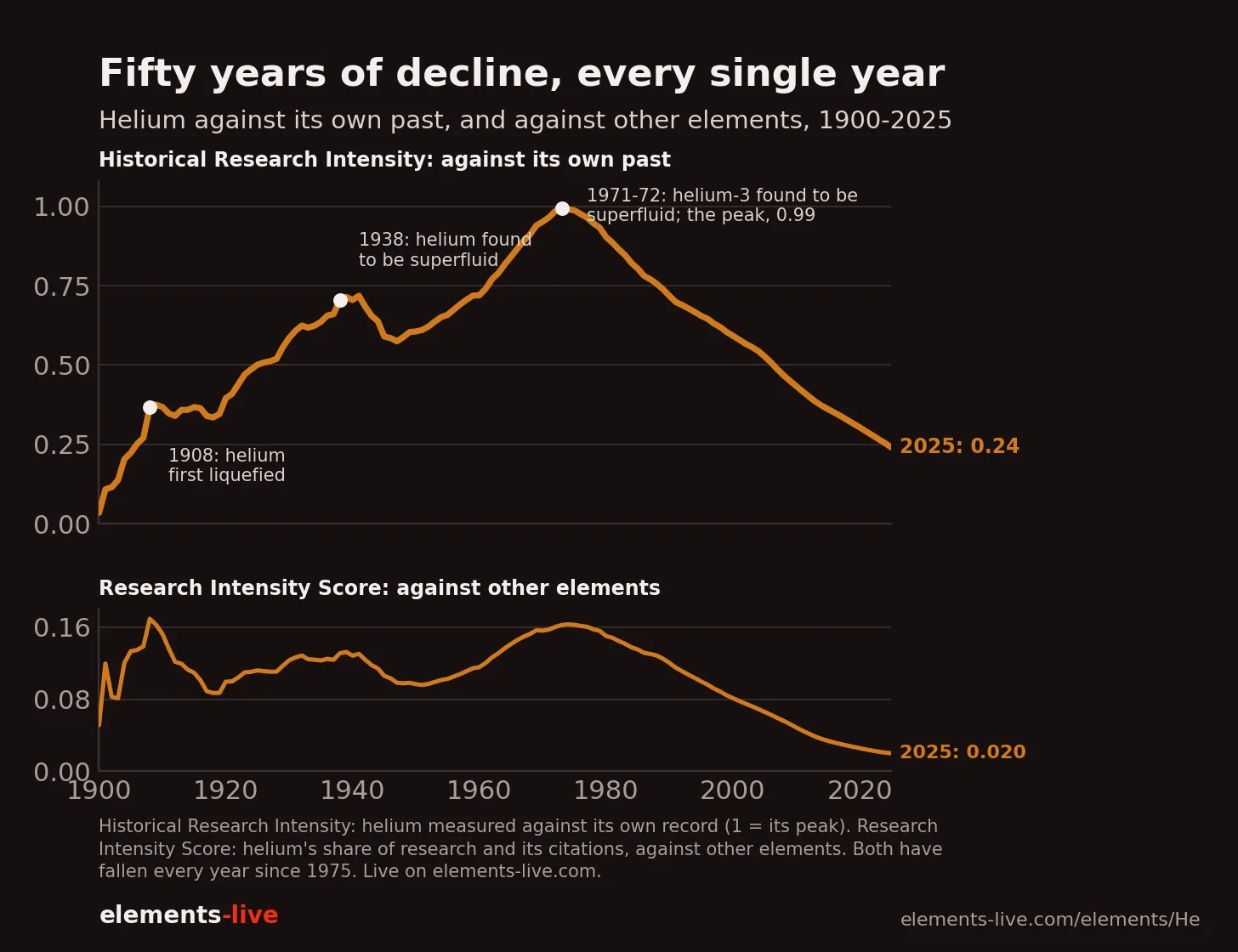
The peak came at a telling moment, because each of helium's big rises followed straight after a discovery about helium itself, when the gas was first liquefied in 1908, found to be superfluid in 1938 and joined by its rare isotope helium-3 in 1971–72, at the very top of the curve, and that was the last great surprise helium had to offer, with the slide beginning within a few years of it. Our records can't say that one caused the other, since a single element is a single case, but the shape is what you would expect of a field that had answered its biggest questions and watched its students move on, and the scores we keep for individual research topics agree, with superfluid helium, superfluidity and helium-4 all reaching their highest research intensity between 1974 and 1976. The count of helium papers kept rising through all of this, from about 15,000 a year in 2016 to about 27,000 in 2025, but more slowly than research as a whole, which is why a score that weighs an element against all of science is the one that tells you how much attention it holds.
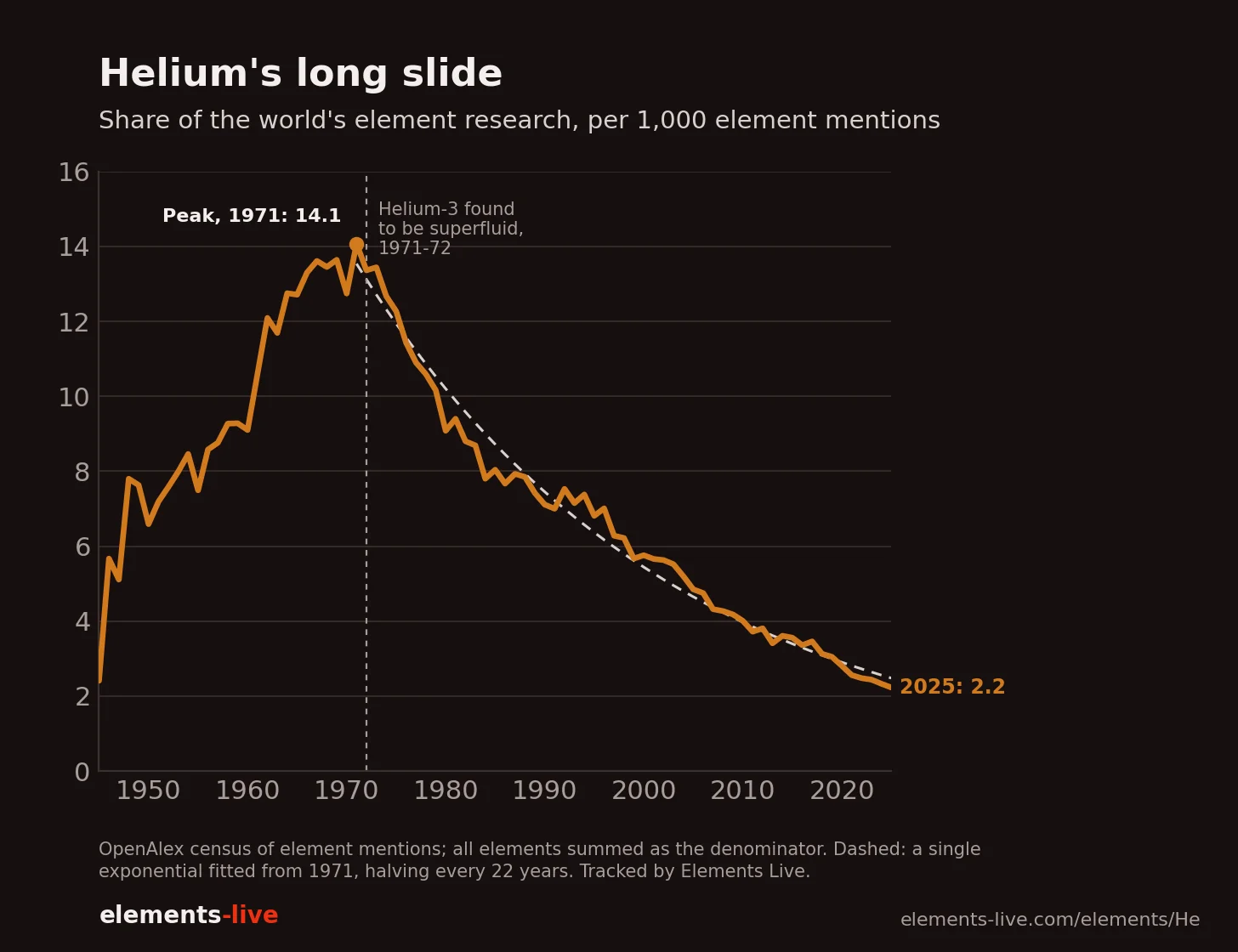
The peak also lines up with the era when helium was a matter of state, when the United States was storing it underground as a strategic reserve and low-temperature physics was one of the fields that defined the Cold War laboratory, and what followed was a slow loss of interest in helium as a subject even as its use as a tool kept spreading.
That is how helium research looks today, with the gas treated mostly as a tool: its largest research community is in astrophysics, tracing how stars and supernovae make helium, at 16.6% of recent helium research, followed by the helium bubbles that form in the walls of fusion reactors, at 11.4%, and by cryogenic cooling and superfluid dynamics, at 10.4%, and in each of them helium is a minor presence, mentioned in about a tenth of the papers as a coolant, a contaminant or a tracer, while very little of the literature is about where the helium comes from.
Four Shortages Before Research Responded
The industry counts five helium shortages in the past twenty years, and our records show how little each of them moved the research on recovering, recycling and separating helium, which we measure as papers per 1,000 helium papers so that the growth of the field doesn't flatter the count.
- 2006–07, when demand outran supply as new plants in Qatar and Algeria came online late: supply research stood at about 6 in every 1,000 helium papers.
- 2011–13, with plant outages abroad and doubt over whether the US federal reserve would keep selling: about 8.
- 2018–20, falling supply after the 2017 blockade of Qatar, ended by the pandemic: about 8 again.
- 2022–23, after fires at Russia's new Amur plant and a shutdown of the US reserve: about 10 in 2022–24, and then 15 in 2025, with 153 papers, more than in any earlier year.
- 2026, with the closure of the Strait of Hormuz and the damage at Ras Laffan taking about a third of world supply offline: the fifth arrived anyway.
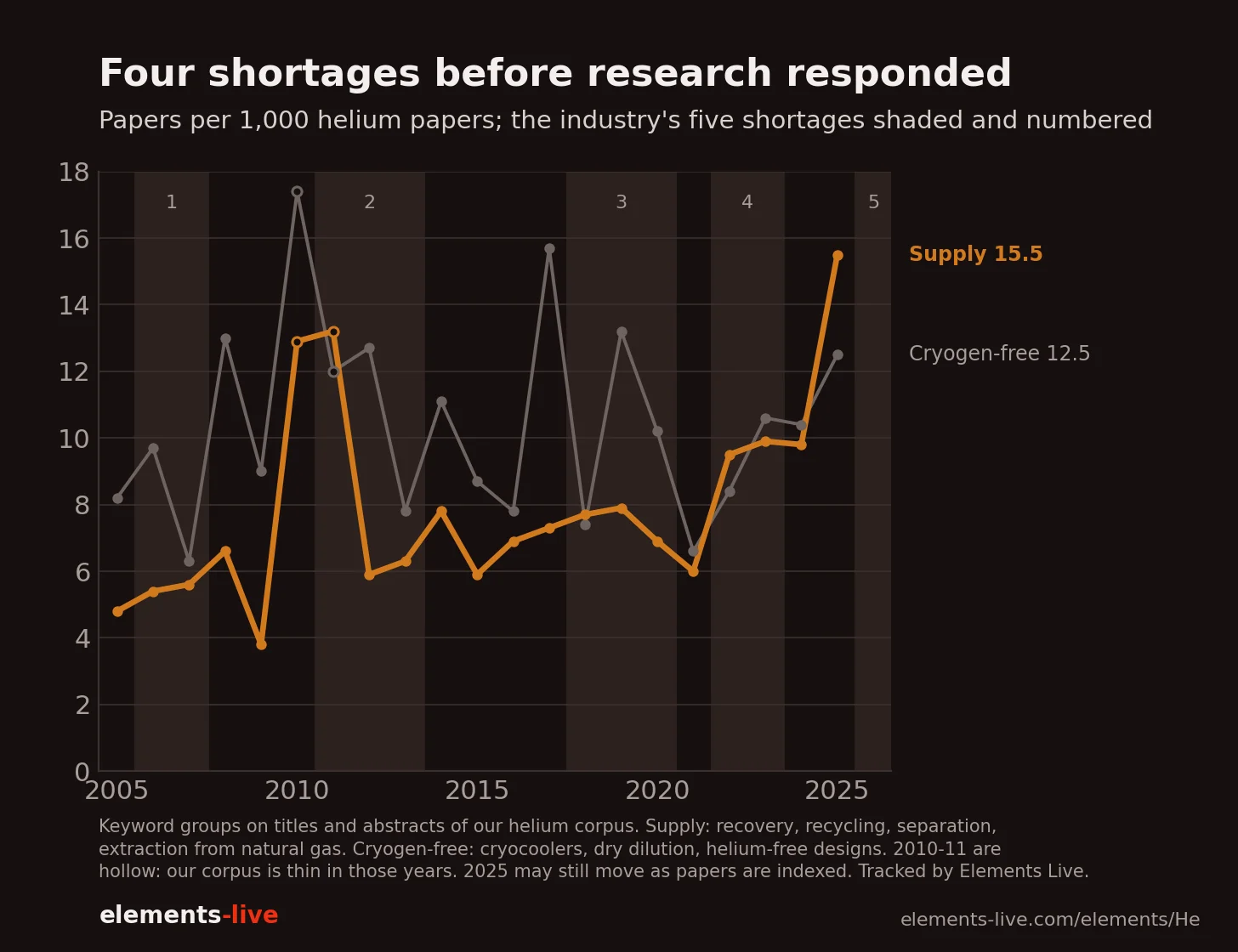
Each of the first three left a small bump in the year or two after it, which faded, and only the fourth produced a rise that held, while research on the other answer to scarcity, cooling without liquid helium through cryocoolers, dry dilution refrigerators and other cryogen-free designs, has run at a steady 8 to 13 in every 1,000 helium papers since 2005, with no visible response to any of the five.
Why Helium Can't Wait
That slowness costs more with helium than with almost any other element, because helium is one of only two elements light enough to rise to the top of the atmosphere and leak into space, so every litre that is vented is gone for good, and what the planet has was made underground, atom by atom, as uranium and thorium break down over hundreds of millions of years, trapped in the same rock formations that hold natural gas. Helium is not mined on its own but stripped out of natural gas during processing, which ties its supply to a handful of gas plants in a handful of countries, so that when a plant stops, a sea lane closes or a reserve shuts, the helium stops with it, which makes it the clearest case we have seen of a material whose supply problem is a refining problem.
Who Works on Which Side
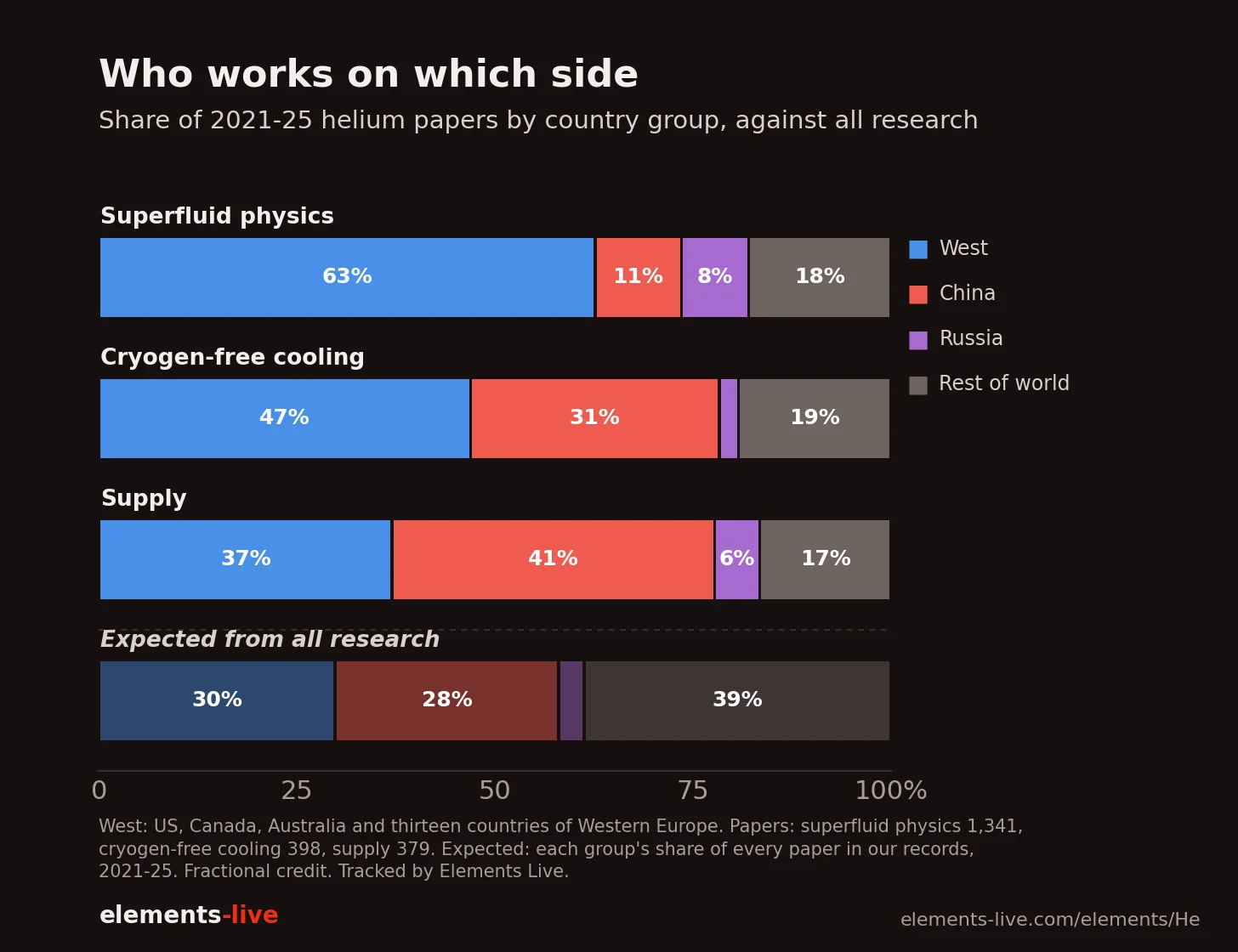
Splitting helium research by country shows that who works on what follows need more than prestige: in the superfluid physics, Western institutions, meaning the US, Canada, Australia and thirteen countries of Western Europe, write 63% of the papers from 2021 to 2025, against the 30% of all research those countries write, with the US alone at 21%, Russia at 8.5% and China at 11%. It is one of the few corners of materials science where the West still writes most of the papers, and Russia, with about 3% of the papers in our records over those years, writes nearly three times its weight, which fits a long tradition in low-temperature physics, while Western institutions also lead the work on using less helium, with 47% of the cryogen-free cooling papers to China's 31%.
The supply research runs the other way round, with China writing 41% of it against its 28% of all research, the US 16%, Russia 6%, Germany 4% and Britain 4%. China imports about 85% of its helium, so its lead looks like what a country does when it is exposed, and the US, a large producer with helium-rich gas fields of its own, still writes about one and a half times its usual weight of supply papers. Across all helium research the pattern holds, with China writing 21% of helium papers in 2025 against 32% of materials research overall, the only large country below its weight, while the US writes 15% against 10% and Germany 7% against 3%, so that China, it seems, is not much interested in helium except in how to get it.
China's supply research is not simply volume either, because measured by citation percentile, where 50 is the middle of each field and year, the supply papers led from China between 2016 and 2023 sit at 50, against 48 for those led from Western Europe and its peers and 39 for those led from the US, so its work is cited at least as much as anyone's. All three kinds of helium research sit below helium's average of about 50, as small fields usually do, with supply at 43, superfluids at 39 and cryogen-free cooling at 37.
Who Is Missing
The surprise in these numbers is not China but the countries that barely appear, Korea and Taiwan, home to the fabs most exposed to every helium shortage, since chipmaking uses helium for wafer cooling, leak detection and controlled atmospheres with no ready substitute, and neither of them writes even 1.1% of the world's helium supply research. For Korea that is less than half its usual share of research, 2.5%, for Taiwan it is no more than its usual 0.9%, and Japan, at 3%, writes about its weight and no more, so the countries whose industries would gain most from cheaper recovery and recycling are not leaning into the open research on it at all, where China, exposed in much the same way, writes half as much again as its weight.
There is a fair objection to this, the one we would expect from anyone in the industrial-gas business, that recovery and recycling are engineering done inside companies, at the gas plants and on the fab floor, and are rarely published. Our patent records let us check it, and they bear the objection out only in part, because of the 140 US patents granted since 2005 on recovering, recycling, purifying or separating helium, the industrial-gas companies hold 54, the oil and gas producers 14, and the chipmakers of Korea and Taiwan a single one between them, Samsung's method for recycling helium from semiconductor waste gas, granted this year. The engineering is real, then, but it sits with the companies that sell helium rather than the ones that depend on it, and even there it moved late, with 15 such patents granted so far in 2026, more than in any earlier year, which suggests that industry, like research, began to move only after the fourth shortage. The open research system, the part that trains students and that governments fund, behaved the same way, and the countries most exposed to the fifth shortage have left the work to others.
Too Simple to Hold Attention
Our records point to one reason science has drifted away from an element this remarkable, which is that helium has almost no chemistry: outside the extreme pressures of a planet's interior it forms no compounds, so the vast and growing body of research on materials, catalysts and molecules, which is where most of the world's papers are now written, has almost nothing to say about it. Helium is useful only as itself, its value lying entirely in its intrinsic properties, the lowest boiling point of any substance, complete inertness and an atom small enough to find the finest leak, so it cools magnets, shields welds and tests seals but is never the ingredient in something new. Its most remarkable properties sharpen the contrast, because a liquid that flows without friction and carries heat better than copper sounds like an engineer's dream, yet it exists only within two degrees of absolute zero, which makes it extraordinarily hard to build into anything outside a laboratory. The other noble gases show the same pattern, and between 1975 and 2025, while the typical element kept about 40% of its Research Intensity Score, neon and krypton kept 10%, helium 12%, xenon 15% and argon 18%, all five among the thirteen elements that lost the most of the 83 we can compare.
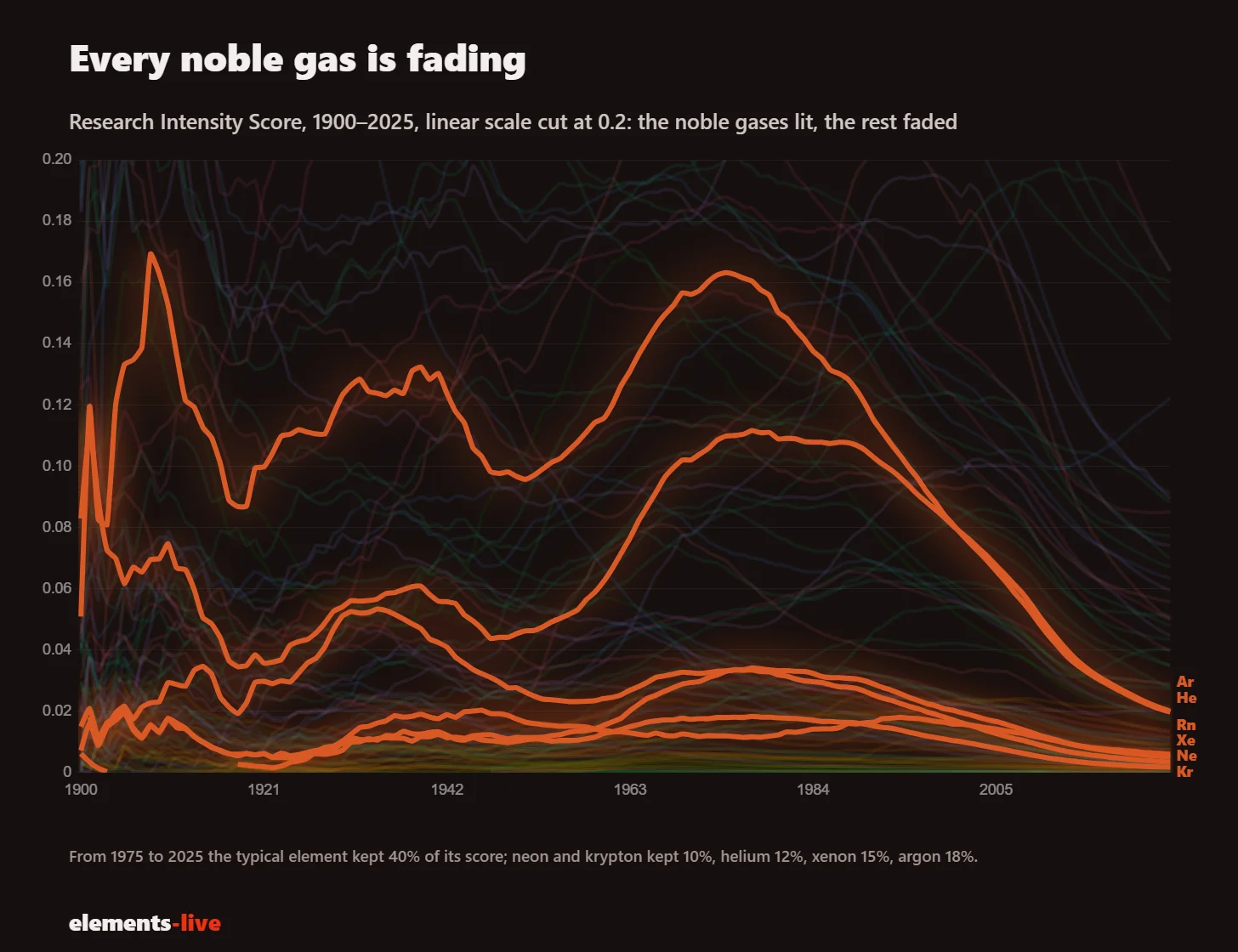
That is a pattern rather than a proof, since elements tied to the Cold War, such as plutonium, radium and beryllium, fell as steeply for other reasons, but it fits helium closely: an element whose physics is extraordinary and whose chemistry is almost empty, in a science that increasingly grows through chemistry.
What the Record Says
None of this is a forecast, since our records can't tell you when the Strait of Hormuz will reopen or what helium will cost next year, and a single year's rise in supply research, however large, is not a trend until it holds, but what they can tell you is how science has spent its attention on the second element. It drifted away from helium for fifty years while industry came to depend on it, it answered four shortages with little more than a shrug, and when it did answer, the answer came from the country that imports helium rather than the ones that make chips with it.
Helium's full research profile, with its history, communities and literature, is free on Elements Live.
How We Counted
- The plain share is from the OpenAlex census of element mentions (yearly counts per element, all elements summed as the denominator).
- The Research Intensity Score weighs each element's share of research and the citations that research receives against every other element, year by year; the Historical Research Intensity measures the same against the element's own record, so 1 is its peak. Both are the scores on Elements Live's element pages.
- Topic groups are keyword filters on the titles and abstracts of papers in our helium corpus: superfluid physics (superfluid, helium-3, quantized vortices, second sound and related terms), supply (helium recovery, recycling, separation, purification, extraction from natural gas) and cryogen-free cooling (cryogen-free, helium-free, dry dilution, pulse-tube and cryocooler). Rates per 1,000 helium papers are used rather than counts, because our corpus coverage changes over time; years before 2005 are left out of the supply chart.
- Country shares use fractional institutional credit: a paper with authors in two countries counts half to each. Baselines are each country's share of all materials research in the same year.
- Citation impact is OpenAlex's citation percentile, normalized by field and year, for papers published 2016–2023 and grouped by the country with the most credit on each paper.
- Shortage periods follow the industry's usual numbering; shortage sizes are from industry and press sources, listed below.
Sources
- gasworld, the helium shortage shows signs of easing (shortage 3.0)
- Innovation News Network, helium shortage 4.0
- Marketplace, 26 October 2026, helium back on the US critical-materials list
- gasworld, Helium Super Summit, 20 October 2026
- CBS News, helium and the Gulf
- NPR, 3 April 2026, Strait of Hormuz closure deflates global helium supply
- Trivium China, China's helium imports