The Napster moment for the knowledge economy
Frontier AI is a subsidy. The capability will outlast it.
Frontier AI is the biggest subsidy I've ever received.
I took Elements Live, a research-intelligence site built on the corpus of materials science research, from idea to a working SaaS in a few months of nights and weekends, for the price of a $20 monthly subscription. In 2023, I reckon the same thing would have cost around $100k and a year, and launched as a lesser version.
It isn't just me. Solo founders went from 23.7% of new US startups in 2019 to 36.3% in early 2025 (Carta), and 63% of companies incorporated through Stripe Atlas in Q2 this year had no cofounder (Stripe).
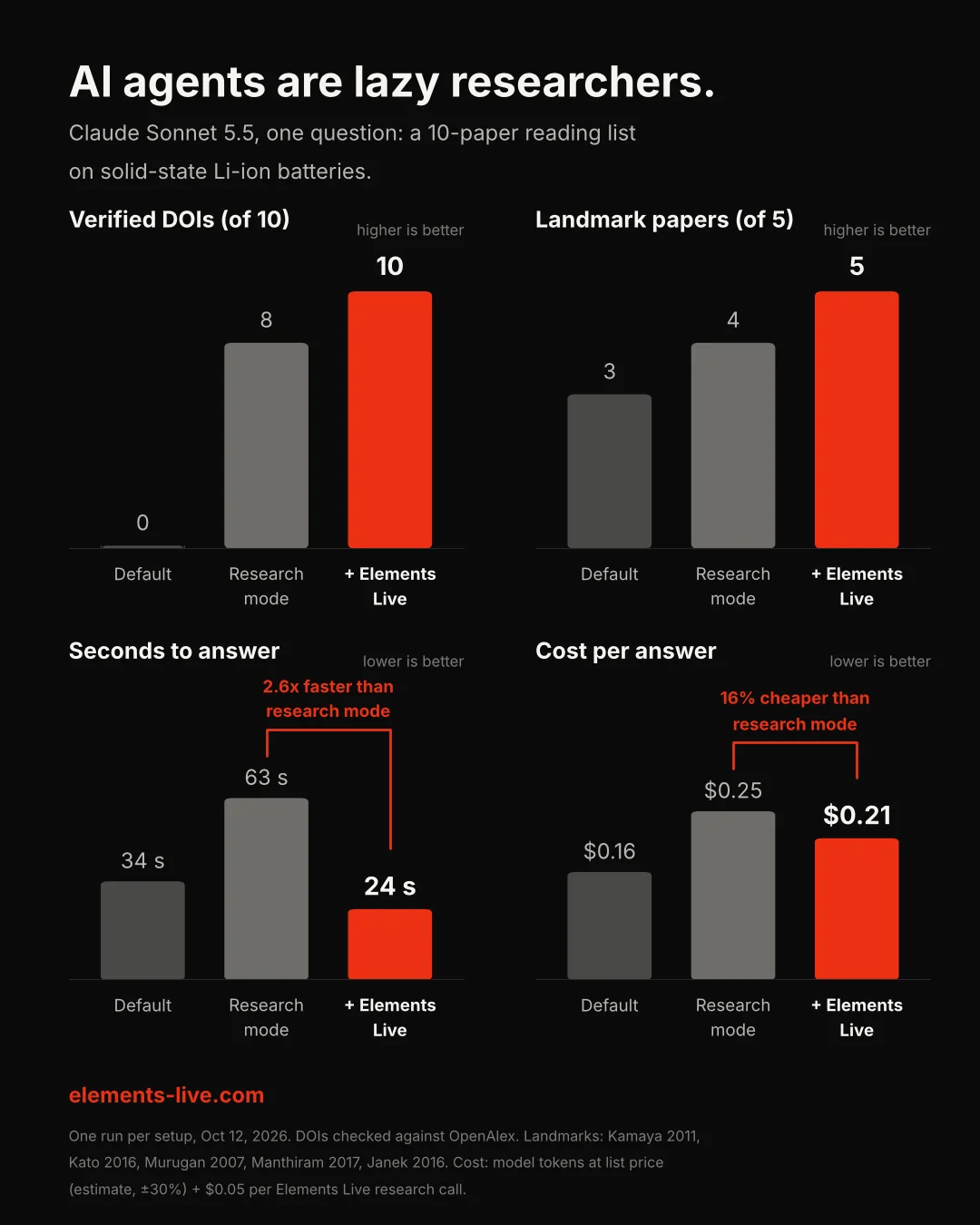
And I don't think the deal gets worse. As I've shown before, with the right harness even a free model running on my desk can ground its research the way a frontier model does.
This is the Napster moment for the knowledge economy. The piracy fights are already back, from the $1.5 billion settlement over pirated books used to train AI to the licensing deals now struck with news publishers. But piracy was only half the Napster story; it was also the era of the iPod, with whole new product lines built on mp3 compression and on the collapsing cost of distributing music. At their core, LLMs are a compression technology too: they distill knowledge until it fits on your PC, the way mp3s did for music libraries, and digital storage did for books before that. It's a fractal that runs back through the printing press, past the written word to cave paintings, likely down to the base pairs of DNA, and maybe below. Every turn made knowledge smaller, cheaper to copy and easier to carry. This turn will too, though you wouldn't know it yet: while we focus on centralized frontier superintelligence, portable intelligence at the edge has yet to make its mark.
The compression works in both directions. A few lines of plain markdown are now enough for a model to decompress my intent into working software. Feature after feature of Elements Live started as a plan in a plain text file, written for the agent that would build it: what to measure, what to leave alone, when to stop and ask. The model unpacked each one into code, tests and a running feature. Even the product works this way: the instructions that teach other people's agents how to research with Elements Live are a markdown file. Intent, written down clearly, has become the most valuable source code there is.
And because the intent lives in plain files, not in any one model, it moves from model to model. I switch between frontier models mid-project, sometimes mid-afternoon, and the work carries on, because the plan, the decisions and the history live in the repo, not in a chat window. The same research tool that grounds a frontier agent grounds the free model on my desk. The model is becoming the decoder; the markdown is the master copy.
It's only fitting that plain text turns out to be the portable layer. My first brush with compression was a framed print at home: my parents' honeymoon photo from the late '70s, printed in characters on a line printer. Their faces reduced to letters and symbols, and you could still see them. The decoder back then was my eye. Today it's a model.
Here's the AI optimist's bearish bet. Today the frontier labs subsidize all of us, and it makes sense to send every question to the cloud. That subsidy won't last forever; the capability will. When the price of frontier AI finally reflects its cost, the economics flip toward the edge: smaller models on our own machines, grounded by good harnesses and steered by plain text. My confidence comes from the one proof we already have: general intelligence running on about 20 watts, inside our own heads. The mp3 didn't need a better studio to change music; it needed a player in everyone's pocket. The edge moment for AI will come when the subsidy ends, and the people who wrote their intent down in plain text will be ready to carry it with them.
…but then again, that's a bet that there is such a thing as a "good enough" model, when eighth graders may soon be launching satellites for their science fair. History rhymes; it just never gives away the ending.