The Suspect Never Confesses
Catching secret nuclear programmes in the scientific record: a detective story told in fifty years of papers, from Pakistan's enrichment years to Iran today.
A detective story told in fifty years of papers, from Pakistan's enrichment years to Iran today, built on the clues a covert programme can't help leaving and the dog that didn't bark.
On the night of 1 June 2009 an Air France jet flying from Rio de Janeiro to Paris disappeared over the Atlantic with 228 people on board. Floating wreckage was found within days, but the aircraft and the flight recorders that would explain what happened lay somewhere on the ocean floor. Four searches over the following year, from the surface down to the seabed, failed to find them. In 2010 the French investigators asked a team of search statisticians to go back over everything, and their insight was that a failed search is a result too, because every place the wreck was not found changes the odds of where it is.
Few people realise that the same method works on mysteries hidden on purpose, not just on those the sea hides, and none has mattered more this year than Iran's nuclear programme. The confrontation over it, which turned into open war on 28 February, is at its core a bargaining failure. States that would both rather avoid a war still end up in one, bargaining theory holds, when each side's private information grows large enough that the two expect very different outcomes from a war. A secret nuclear programme is the textbook case, and the most dangerous one, because for the adversary even a low probability of success carries a large expected cost. For the state building it, the rational course is never to publish the core work so as not to hand the other side the evidence it needs to price that cost. This chain of reasoning invites the old fallacy of security through obscurity, a paradigm that can’t hold in a world where thousands of relentless genius minds can be spawned on a whim at the cost of just electricity.
The First Clue Was a Silence
The lesson had been learned once before, by a young Georgy Flerov, fresh off his own discovery of spontaneous fission. Early in the war he noticed something odd in the American, British and German physics journals reaching Moscow. The papers on fission, which had poured out since its discovery in 1938, had stopped. Nobody had announced anything, but the silence itself told him that the work had become secret, and that meant someone was building a bomb. The void he wrote to Stalin about is visible in our records as well. Papers on nuclear fission fell from 35 in 1939 to one a year from 1942 to 1944, while science as a whole shrank by only about 40% during the war.
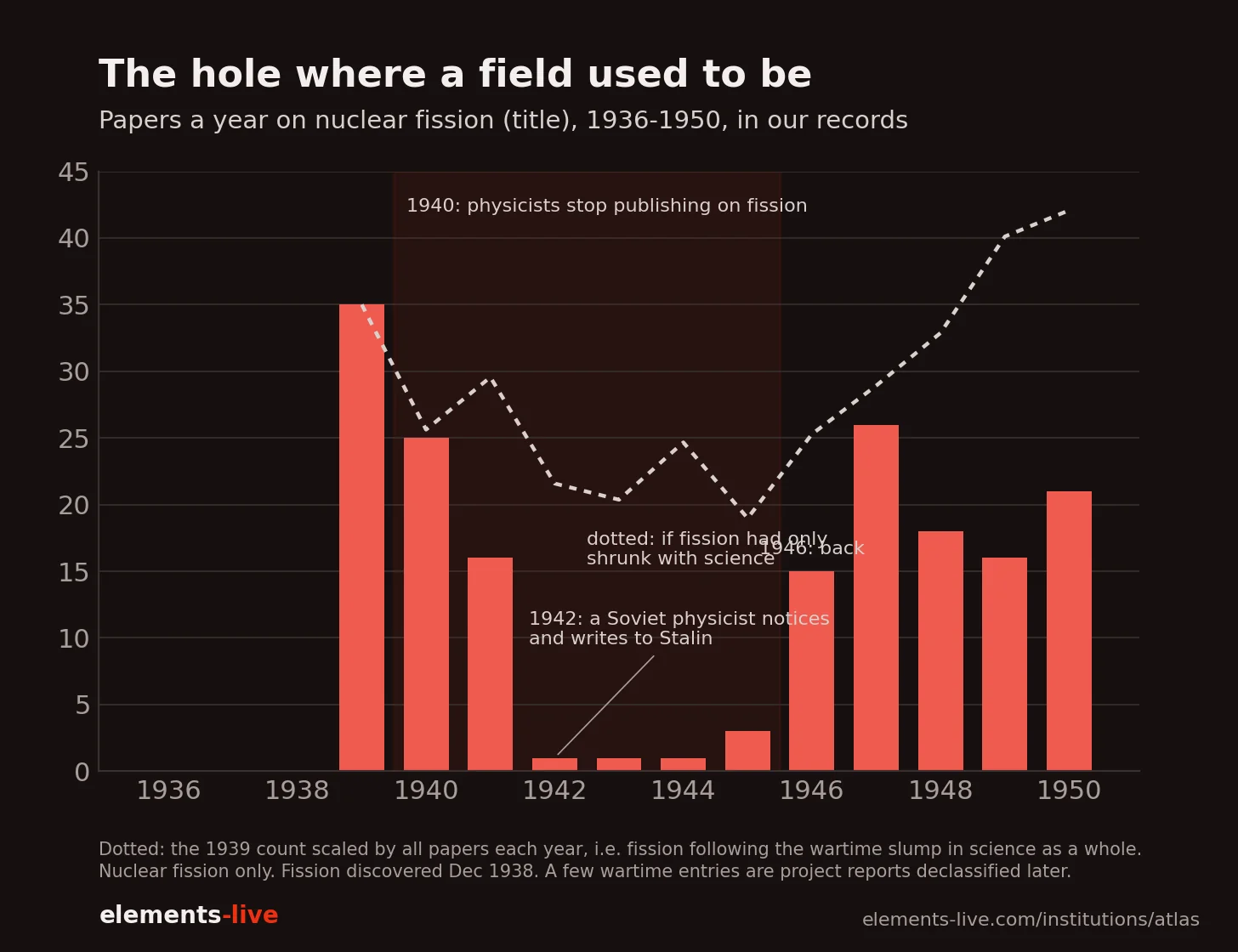
The silence, of course, was deliberate, as from 1940 physicists in America and Britain had agreed among themselves to stop publishing on fission. Within a few years the work and the people doing it had been quarantined behind the fences of closed cities like Los Alamos, which existed on no public map and whose scientists shared a single post-office box. But a quarantine is visible from outside as a hole where a busy field used to be, and it isn't the only trace a programme leaves. A programme on the scale of a bomb needs hundreds of chemists, physicists, metallurgists and engineers, and it trains more of them than it can hide. As with the Manhattan Project and later the space programmes, the open science around it tends to grow while the core stays dark. We can't see past a black hole's event horizon, but we can still detect it by the flurry of activity its gravity induces in the surrounding space. The matter swirling around it can practically outshine whole galaxies and the jets it drives can set off the birth of new stars nearby. Around a programme the glow comes from the fields it can't do without: radiation detection and dosimetry, which it needs both for its own safety and to know what an inspector's instruments can see; the chemistry of finding, separating and measuring uranium; nuclear data; and the materials around reactors and centrifuges.
Failure Is Evidence
A silence and a glow are only clues, though, and over the Atlantic the statisticians had shown that a clue is worth exactly as much as the instrument that turned it up. Not every failed search counted the same. They lowered the odds wherever a search had looked by only as much as that search would have been likely to spot the wreck had it been there, and they laid every failure over a single map of probability together with the plane's last known position and the drift of the floating wreckage. The method itself was older than the plane, born in the operations research of the Second World War, when mathematicians were set to work on finding submarines at sea. In the same years another group of statisticians was handed a problem that looks, at first, like its opposite, not one plane that nobody could find but hundreds that came home. American bombers were coming back from missions over Europe riddled with bullet holes, clustered along the wings and the fuselage. An engineer’s obvious next step was to add armour where the planes seemed to sustain the most damage, but a statistician's insight was that the planes that never came back had to be counted too. The survivors were the lucky ones, and their holes mapped only the damage a bomber could take and still fly home, so the extra armour belonged where they showed the least.
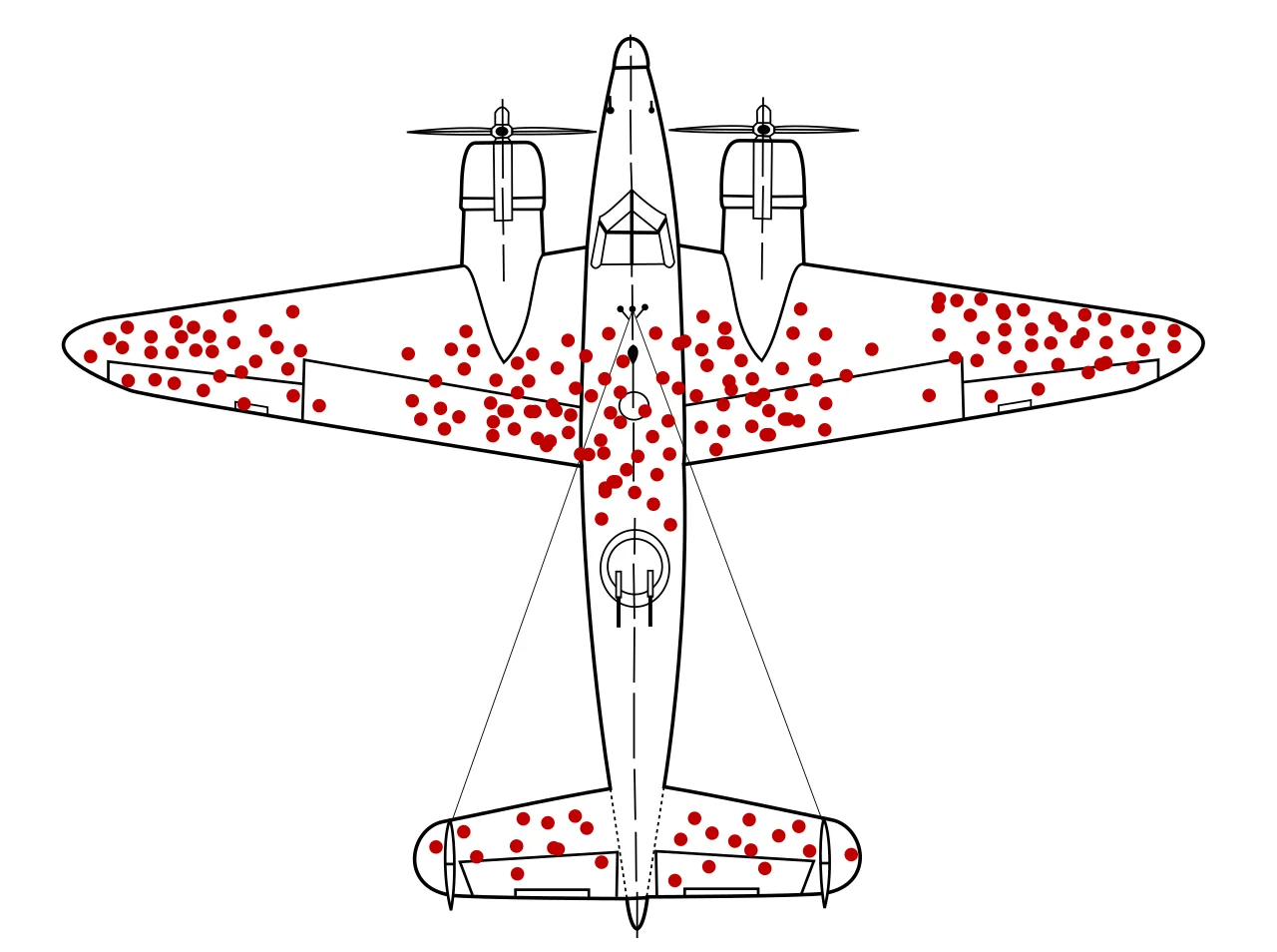
Both problems rest on the same rule: you look where the thing is most likely to be, multiplied by the chance that you would see it if it were there, and what you don't see counts too, but only as much as your instruments deserve.
Innocent Suspects
The instrument here is built from our records, which group the world's materials and chemistry papers into communities of researchers who cite one another. Fifteen of those communities are nuclear: ten around the fuel cycle and reactors, from separating uranium, thorium, caesium and strontium to reactor physics and fusion, three in radiation shielding and dosimetry, and two in nuclear medicine. Dividing a country's share of the world's papers in those communities by its share of everything gives a gauge that reads 1.0 when a country writes as much nuclear science as its size predicts. The ratio strips out the growth or decline of its science as a whole.
Taken alone, a high gauge would fill the line-up with the innocent. Belgium read 1.7 or more through the late 1970s and 1980s, because it hosts one of Europe's large civilian nuclear research centres. Egypt and post-communist Romania have read around 2 for decades on the output of their atomic energy agencies, and Kazakhstan and Uzbekistan do the same on the Soviet nuclear institutes they inherited. A high level says a country specialises in nuclear science, which is a profession, not a motive. The signal, where there is one, is in the change, the moment a country's behaviour departs from its own habits.
Closed Cases
A method has to be tested on cases already solved, so we ran the gauge on every country that pursued nuclear weapons, or came close, in the period our records cover, with the programme years taken from the public record.
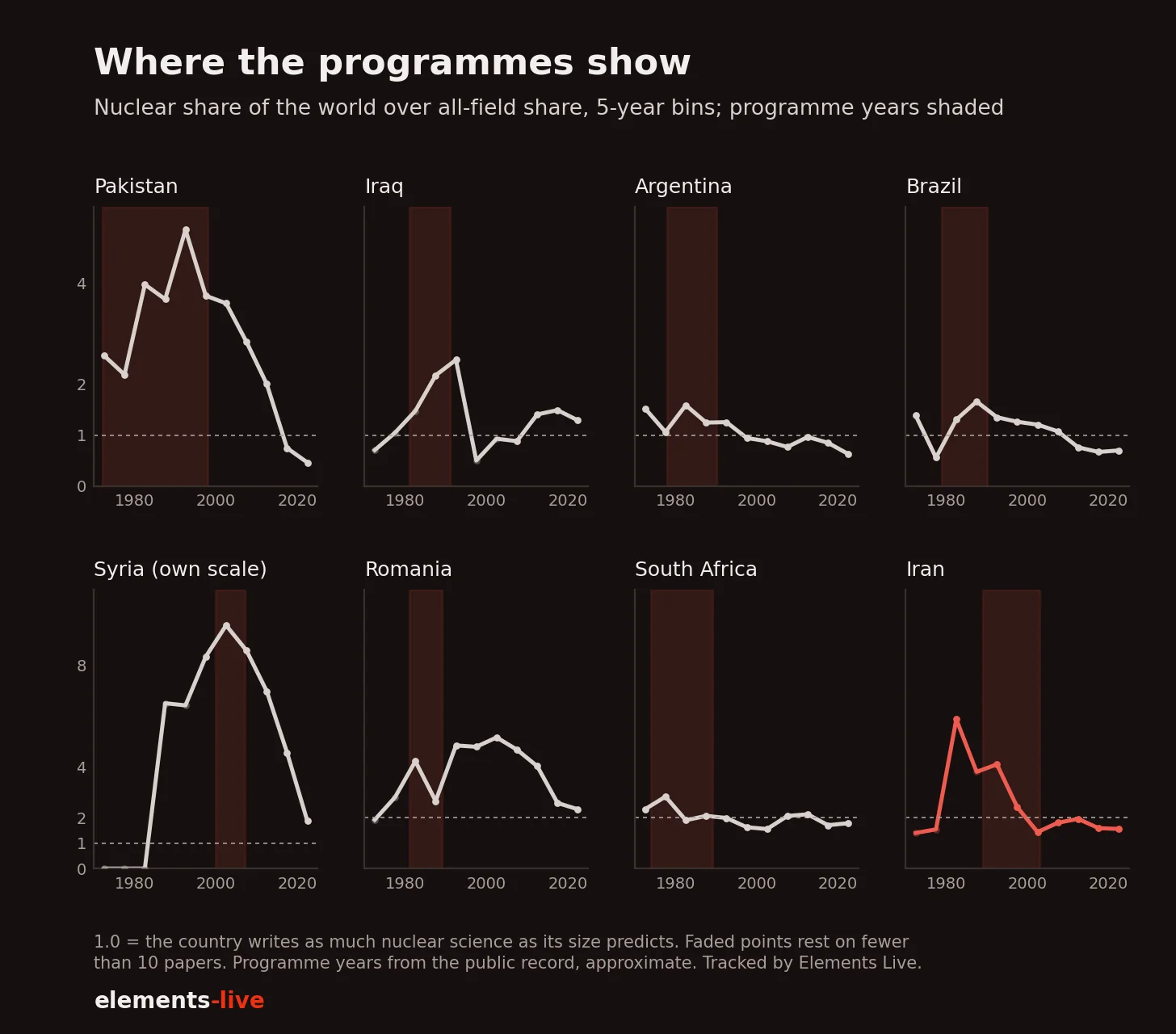
It catches some of them clearly. Pakistan's gauge jumped to about 4 in 1980–84, the years when its secret enrichment plant at Kahuta was being built and brought into operation, and stayed between 3.5 and 5 until after its tests in 1998. Iraq's doubled to 2.2 in 1985–89 as its covert programme accelerated. Romania's rose to 2.1 in 1980–84, years in which, as it admitted to the IAEA only in 1992, it was separating small amounts of plutonium. Argentina's peaked at 1.6 in the same years, around the secret enrichment plant it announced in 1983. Brazil's rose more gently, from 0.6 to about 1.7, during its parallel military programme of the 1980s.
Others got away. South Africa built six nuclear weapons in the 1980s, and its gauge barely moved. Taiwan's sat just at the line in the early 1970s and faded, Libya registers once, very high on a handful of papers, and South Korea and North Korea published too little in these fields, or nothing, for the gauge to read at all. Syria reads very high, around 9 in the 2000s, but its rise began in the 1990s, years before it started building the reactor that was bombed in 2007. Its atomic energy commission is one of the country's largest research publishers, and the reactor itself never appears in the papers.
The Silent Beacon
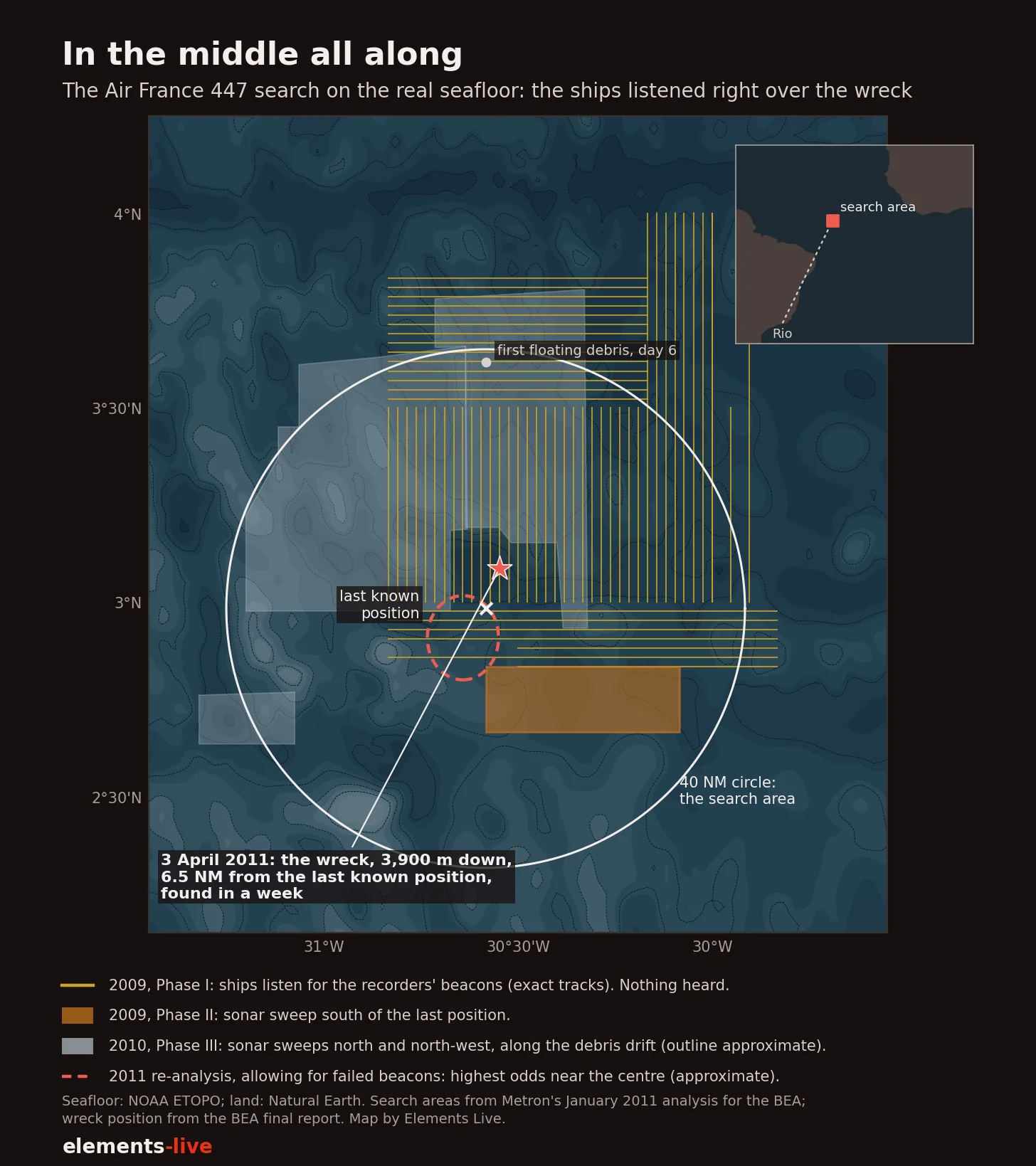
The search in the Atlantic had run into the same problem, an instrument that stays silent over the very thing it was built to find. One of the four failed campaigns had listened near the plane's last known position for the underwater beacons on the flight recorders and heard nothing, and the silence had been taken to mean that the wreck wasn't there. The statisticians' main map took that silence at face value, but they also asked what would follow if the beacons had simply failed. On that second map the most likely place moved back towards the centre, the area everyone had written off. The investigators chose to search there first. An instrument that sometimes fails still carries information, as long as its failures are priced in.
The earlier searches had a quieter bias too. When the sonar ship went out in August 2009, the patch of seabed it swept was chosen partly because the bottom there was flat, where its sonar worked best. The search went where the instrument could see as well as where the wreck was likely to be. The gauge has the same habit, since it can only read countries that publish, which is why North Korea never registers at all. So does this whole story, read as it is from published papers, the one place a secret programme takes care never to be: it is a search under the streetlight, and it is honest only if it prices in what the light can't reach.
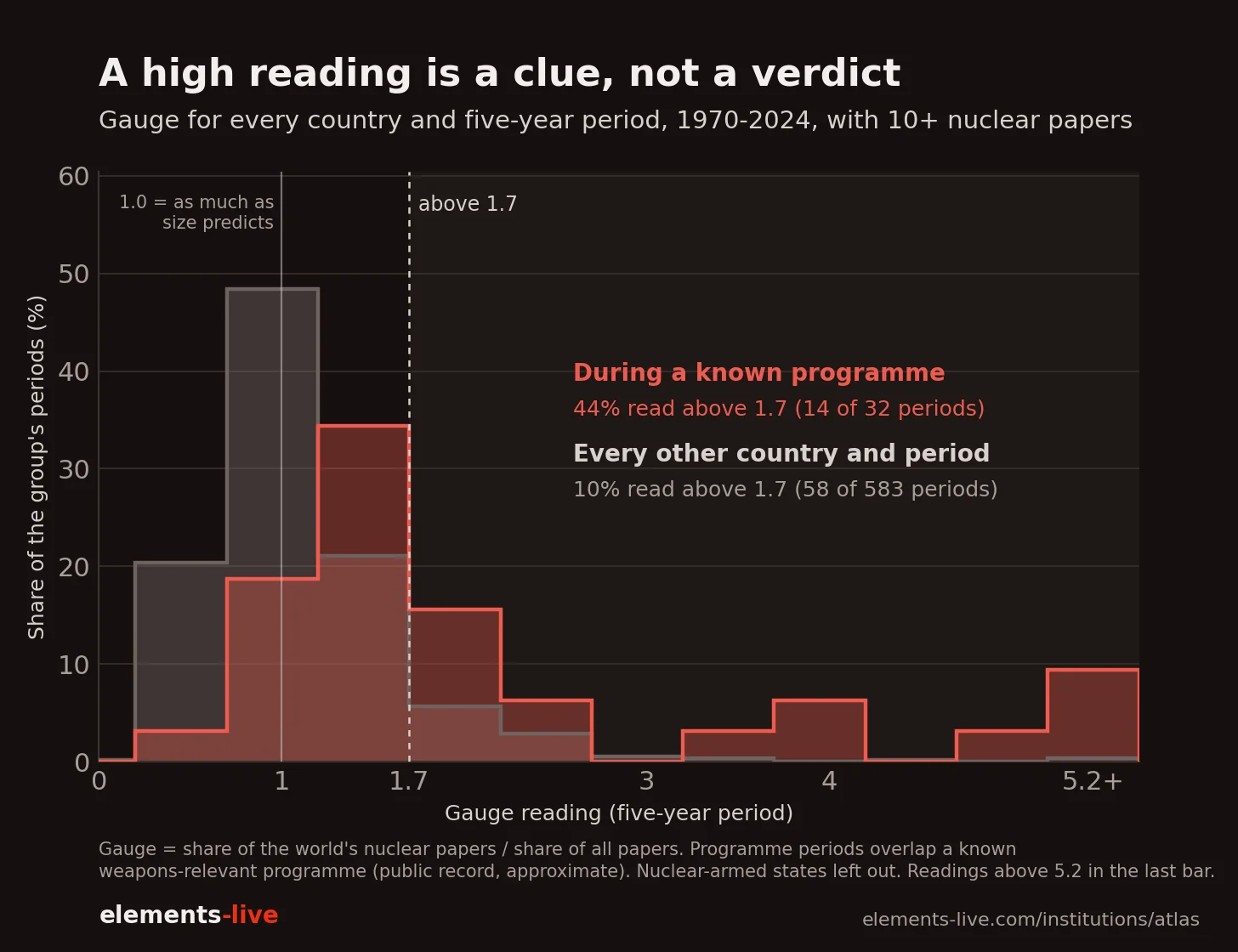
Counted that way, across the 32 five-year periods in which a programme was running and enough papers exist to read, the gauge was above 1.7 in 14 of them, 44%, against 10% everywhere else. A high reading is about four times more likely during a programme than outside one. That is real evidence but not proof, because most countries never pursue a bomb and four times a small chance is still a modest one. It is one clue to be weighed with others.
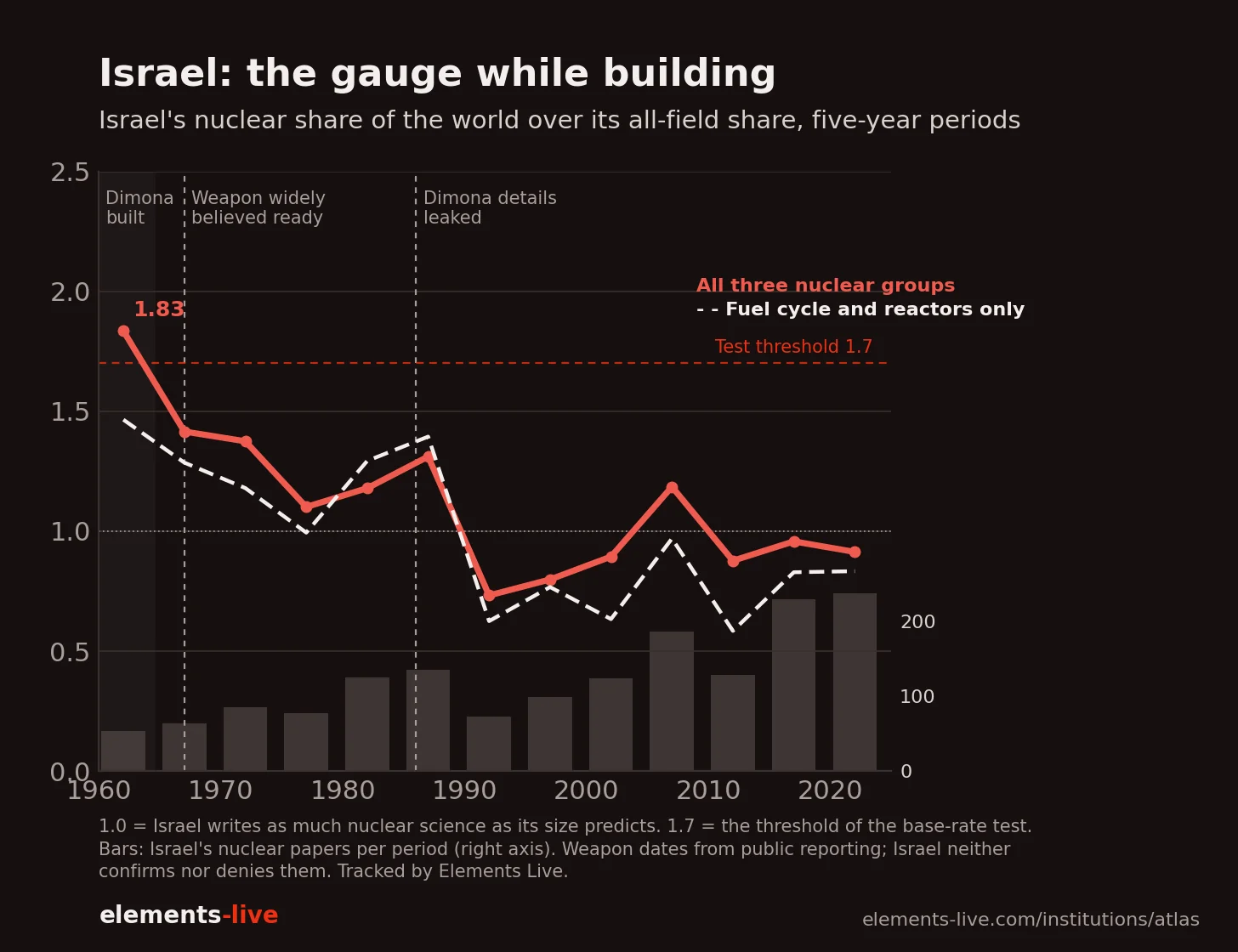
One case sits outside the test because it came too early. The test starts in 1970 because in the two decades before, nuclear science was the frontier every advanced country wanted a part of. Nearly every one that built a research reactor reads high, from Argentina and Taiwan to Belgium, Denmark and Norway, so a high reading said more about modernity than about motive. Israel has never confirmed that it holds nuclear weapons, but its reactor at Dimona was built in the early 1960s and a weapon is widely believed to have been ready by about 1967. In the years of construction, Israel's share of the world's nuclear papers ran at 1.83 times its share of all papers, above the threshold the test uses. The reading then eased through the 1970s, rose again in the 1980s and settled below 1.0 after 1990, where it has stayed. The gauge picks up a programme while it is being built and loses it once the work is finished and moves out of sight, which is also why the established nuclear states don't stand out on it today.
Fingerprints
In the years Pakistan's gauge peaked, what reached the journals was everything around the core. Most of Pakistan's nuclear papers in those years came from its atomic energy commission and the research institute it runs, and they read like a list of what a programme needs to know. There are papers on finding uranium and thorium in the ground with alpha-sensitive films, on detecting neutrons and measuring their doses, and on fission induced by 14.8-MeV neutrons. In 1986 the institute published measured fission cross-sections for neptunium-237 and four isotopes of plutonium, the kind of nuclear data that reactor and weapons designers both rely on.
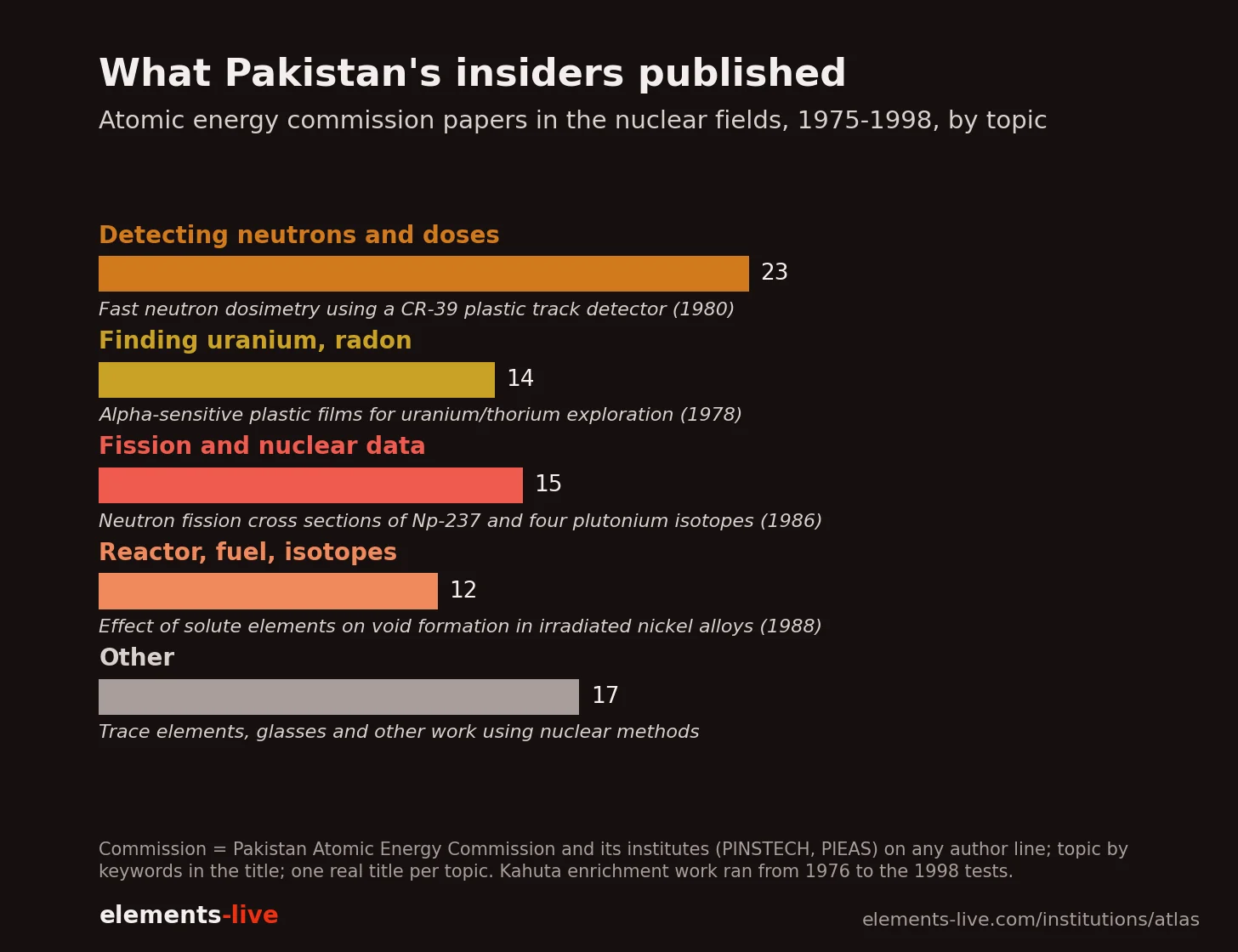
None of it is the secret, only the knowledge around it, published openly and much of it with partners abroad.
Nobody inside these programmes has explained why the trace exists, but the plausible reasons are ones no security service can fully manage. The first is human nature, since the people inside a programme are still scientists, who want their work seen by their peers, are hired and promoted on what they publish, and train students who must publish to graduate. The agencies that employ them are judged on output too, which is how Syria's atomic energy commission came to be one of that country's largest research publishers. The second is that research doesn't run on rails, and the road to a weapon wanders through side questions, dead ends and problems that turn out to matter elsewhere. Since nobody can know in advance which result will prove sensitive, much of the work is published before anyone thinks to classify it, while the branches that lead away from the bomb stay open as ordinary science. The knowledge a young programme needs mostly arrives through cooperation, students trained abroad, a research reactor from a foreign supplier and joint projects of the kind Atoms for Peace set off, and that help comes with the expectation, sometimes a condition, that its results are published. And whoever clears a paper for publication judges it on its own merits, asking whether this one gives anything away, not what a thousand cleared papers say together, so the signature is assembled from papers that each passed on their own. No one of these paths is likely to give much away, but each has a chance above zero, and across thousands of people and papers over many years, small chances add up to a baseline of papers that is all but inevitable. It is against that baseline that both clues show, the glow around a programme and, when its core goes dark, the silence where a busy field used to be.
The Dog That Didn't Bark
The bullet holes on the returning bombers are the loud watchdogs that draw our attention away from the dog that did not bark. They marked, as the wartime statisticians pointed out, the places a plane could be hit and still fly home. The armour belonged where the returning planes had no holes at all, because the planes hit there were the ones that never came back. The evidence that mattered was in the planes nobody could inspect.
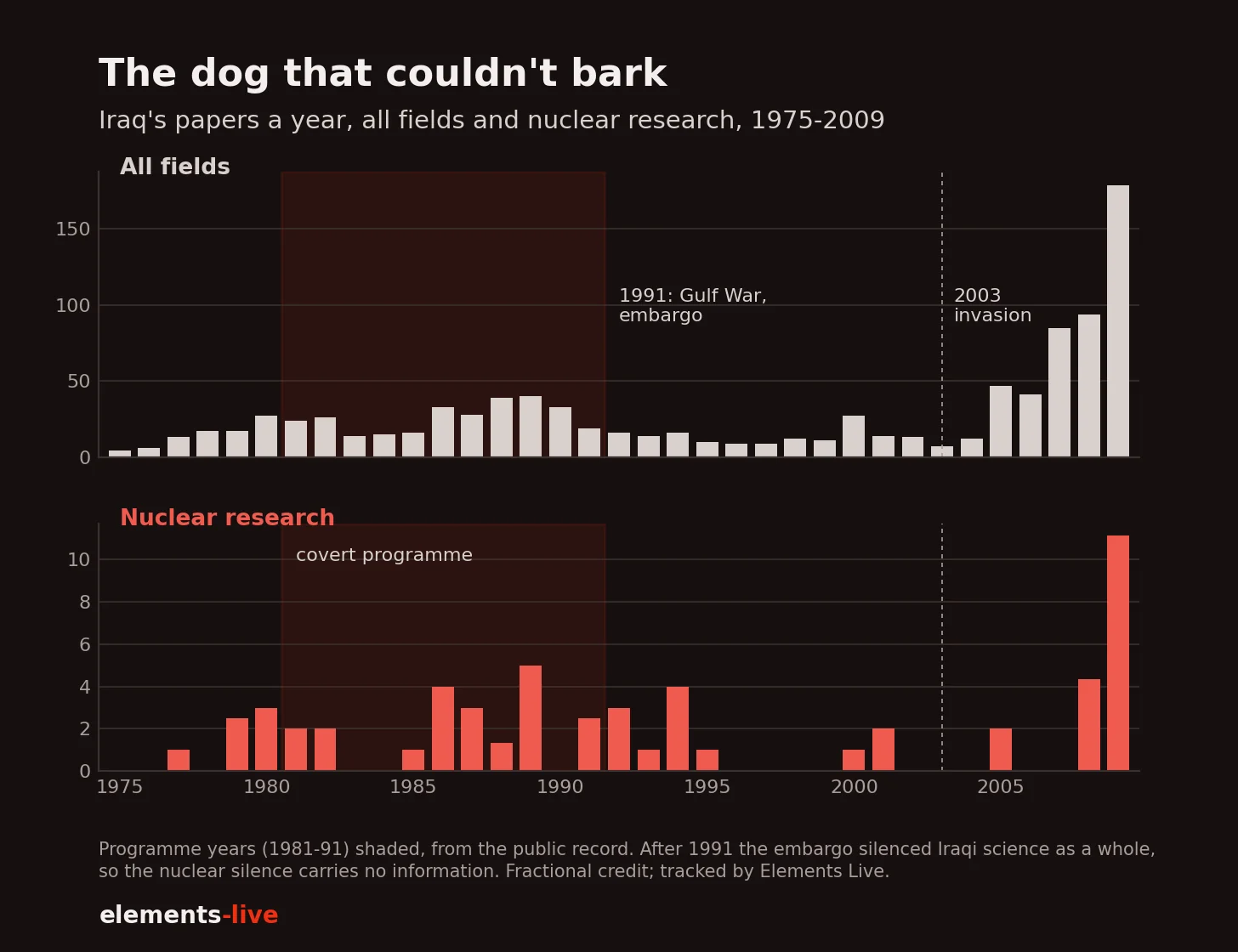
Iraq's atomic energy commission published one or two papers a year in our records through the 1980s, while running one of the largest covert programmes of its time. Its last papers before a twelve-year silence, in 1991–93, were about measuring uranium, including impurities in nuclear-grade uranium compounds, the analytical chemistry a fuel-cycle programme depends on. The rest of Iraq's nuclear papers in the late 1980s, about a dozen, came from its universities and were mostly about detecting neutrons and alpha particles, which a programme needs for safety and for knowing what can be detected. A dozen papers can't carry a conclusion on their own, but with the silence they show both kinds of trace in one country. How much a silence counts depends on how loudly the dog should have barked: an agency that ought to be publishing and goes quiet says far more than a country that never published at all.
Iraq also carries the most famous misreading of all. Most people now remember the weapons of mass destruction that justified the 2003 invasion and were never found. The American survey group that searched the country afterwards concluded in 2004 that Iraq had not restarted its nuclear programme after 1991. The programme before 1991 was real. Inspectors who went in after the Gulf War documented and dismantled it, from uranium enrichment to a crash effort in 1990 to build a weapon. That is the programme the gauge caught in 1985–89. After 1991 the dog couldn't bark at all, because under the embargo Iraq published almost nothing in any field, too little to read either way. That silence carried no information, and the error of 2003 was to read a dog that couldn't bark as one keeping quiet.
Found in a Week
Over the Atlantic, the new search began in 2011 near the centre, in the area the silent beacons had seemed to rule out. It found the wreckage within a week, almost four kilometres down and 6.5 nautical miles from the last known position, not at the very peak of the map but close to it. No single clue had found it, and one had actively misled. The drift of the floating debris, which poor current data made unreliable, had pulled the 2010 search north-west and away from the wreck. Only by weighing every clue by how far it deserved to be trusted, the last known position, the four failed searches, the misleading drift and the chance of a broken instrument, did the map point to the right patch of seabed.
One plane went down and couldn't be found, and hundreds came home and turned out to be the wrong ones to study. Both puzzles were solved, seventy years apart, by people who learned the most from the planes they couldn't see. A secret programme is the plane that never comes back.
The Open Case
Iran is the case still on the desk, and the one where not being able to see has cost the most. Its gauge has hovered around 1.0 in this century, so Iran writes about as much nuclear science as its size predicts, and the signal is in the change.
What moved the gauge
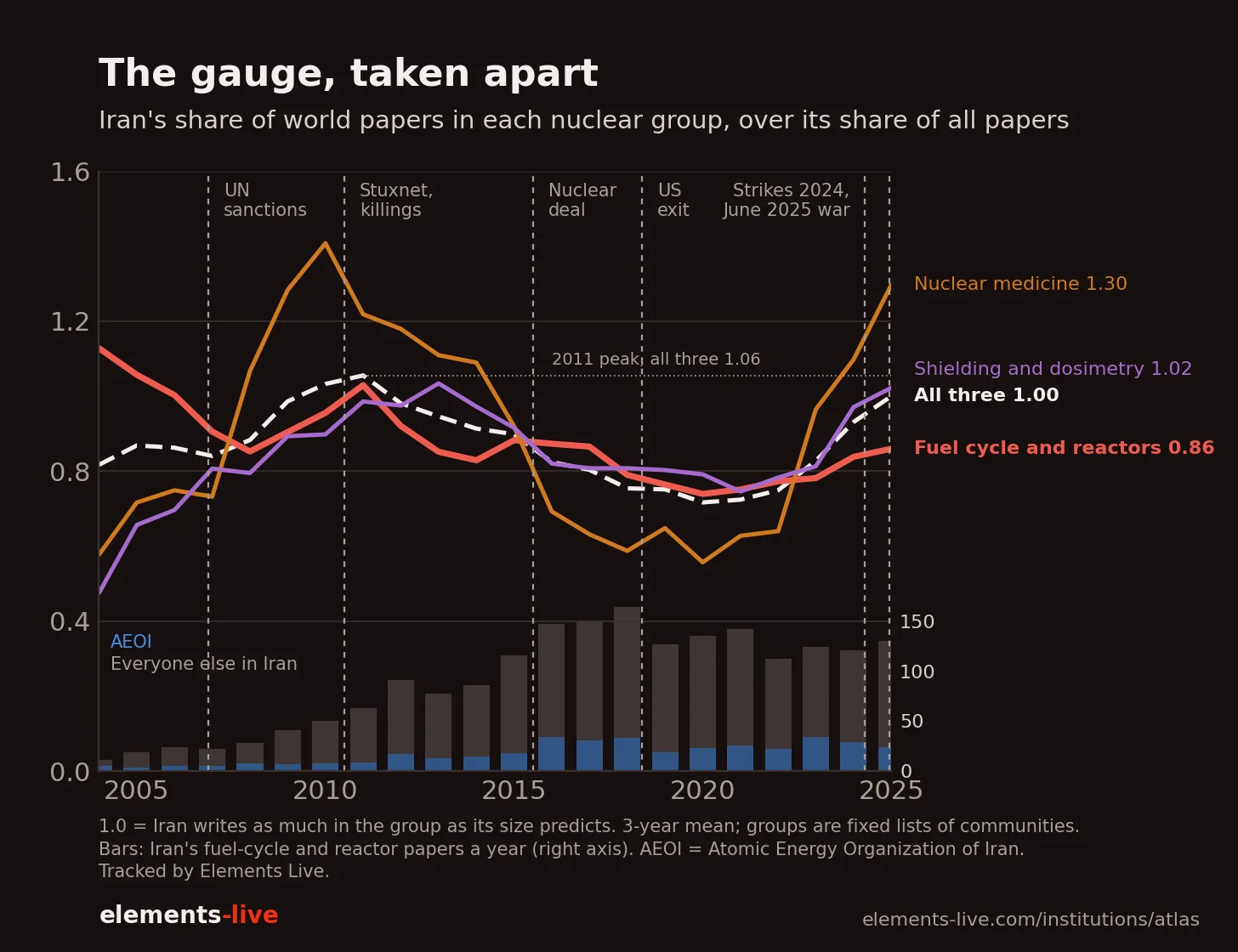
Read against the events, the gauge moves with them. Taken together, it rose from 0.82 in 2004 to 1.06 in 2011, through the years when the enrichment plant at Natanz was built up and the UN sanctions arrived. The part that rose fastest was nuclear medicine, which more than doubled, to 1.41 by 2010, the year Iran gave fuel for the reactor that makes its medical isotopes as its reason for enriching uranium to 20%. The gauge turned down just as the Stuxnet worm and the killings of nuclear scientists in 2010–12 hit the programme, falling by about a seventh by 2015. A handful of deaths can't remove a seventh of a field's papers on their own, so the likelier reading is a shift in what got published, with more of the work kept behind closed doors. Since papers trail the lab work behind them by a year or two, and the fields around a programme trail its core by longer, every turn in the gauge marks a turn in the programme some years before.
What the deal bought
The 2015 nuclear deal is usually remembered as either having stopped the programme or having failed to, and the gauge suggests something in between. It was designed as a good-faith attempt to solve both of bargaining theory's problems at once, with inspections standing in for trust about capabilities, and limits exchanged for sanctions relief in reversible steps, so that either side could walk back if the other cheated.
Read through the gauge, the deal sits in the middle of one long decline rather than at either end of it. The fall began in 2010 with the sabotage and the killings. It paused in the deal years, when the fuel-cycle and reactor work held level at about 0.87 from 2015 to 2017 and the AEOI's own papers in it doubled in 2016, the deal's first full year, as sanctions relief and the civilian nuclear cooperation the deal provided for reached exactly these fields. The core then drifted lower, to its bottom of 0.74 in 2020–21, with the gauge as a whole at 0.72, the lowest in the series, though no single year's fall was larger than the gauge's usual swings. Since papers trail the work behind them by a year or two, even the drop of 2018 reflects work done before the American exit that May. From 2021 the gauge climbed every year, faster than at any point before, back to 1.00 in 2025, close to its 2011 peak. Those were the same years in which Iran enriched uranium to 60%, the highest level it has reached, and the confrontation turned into direct strikes. If the gauge tracks the work it can't see, it is also a ledger of what the deal bought: years in which a decline already under way paused, not the years in which it began or ended.
Bomb or clinic?
That "if" carries a lot of weight, because the parts of the gauge haven't moved together, and the rise could be the weapons work growing or talent moving out of it. The fuel-cycle and reactor core has won back less than half of what it lost, to 0.86, while shielding and dosimetry is back at 1.02 and nuclear medicine has more than doubled since 2020, to 1.30. The Atomic Energy Organization of Iran, the agency that runs the programme, has written a steady 40 to 45 papers a year in these fields since 2022. Like the bombers that made it home, its papers show only what was allowed to come back. Most of the growth came from Iran's universities and hospitals, in nuclear medicine and radiotracers, from about 42 papers in 2023 to 81 in each of 2024 and 2025, and in radiation-shielding materials, new stars around the black hole rather than light from inside it. Nothing in the open record says how closely that growth follows the weapons work. If talent is moving out of restricted work and into the clinic, the gauge would rise as the part of the programme that worries the world shrank.
Medicine isn't obviously the innocent part, though. It rose before, peaking in 2010, a year ahead of the core, in exactly the years when Iran was preparing to enrich to 20% in the name of medical isotopes and when there was near-unanimous agreement that its programme was growing. It is also the faster signal, swinging about three times as much from year to year as the core. At each turn it has moved about a year ahead of it, rising in 2008, peaking in 2010 and jumping again in 2023. Taking medicine out altogether, from Iran's papers and from the world's, leaves a gauge that stood at 1.01 in 2011 and at 0.92 in 2025, after climbing every year since 2021. Talent may still be moving within these fields in ways the papers can't show, but a move into the clinic can't explain the whole rise.
The programme's own institutions show where its weight sits. The AEOI writes about 1% of Iran's papers but more than a quarter of those on reactor materials and on separating uranium from solutions. In the narrowest slice of all, separating thorium during the recovery of uranium from ore, the front end of the fuel cycle, Iran writes 6% of the world's papers since 2015 and the AEOI 40% of Iran's. Malek Ashtar University of Technology, which belongs to the defence ministry, leaves a similar trace in the materials around military hardware, from thermal-barrier coatings and high-performance alloys to ferrite and carbon materials for electromagnetic uses such as radar absorption.
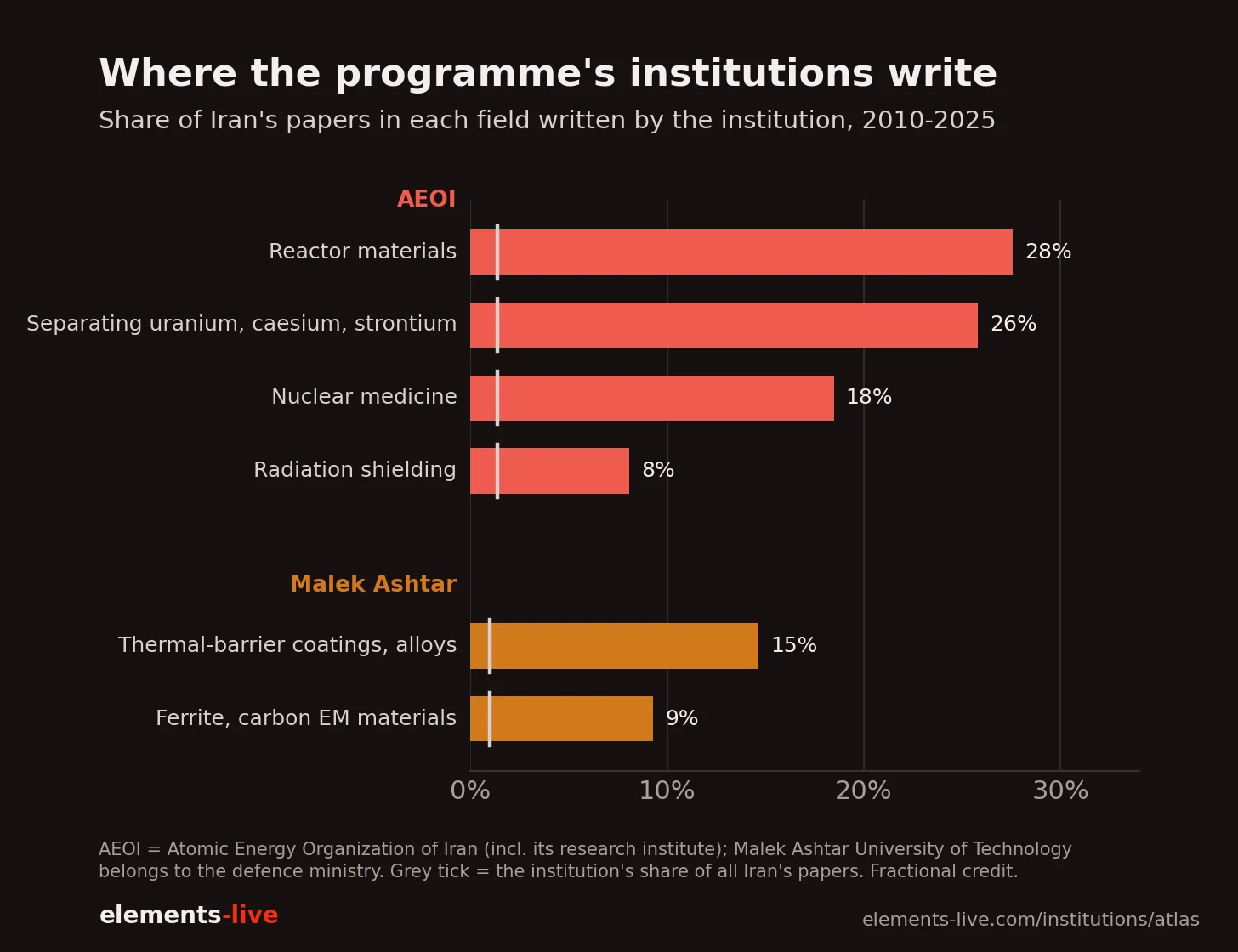
What doesn't appear is as telling as what does. In the named slices at the heart of a weapons programme, plutonium separation and reprocessing, plutonium and uranium forensics and mixed-oxide fuel, Iran's share is zero or close to it.
The most direct leak runs through isotopes. Some of the radioisotopes medicine uses can only be made by irradiating targets in a nuclear reactor, while others come from cyclotrons that need no reactor at all. In 2010 Iran gave fuel for the Tehran Research Reactor, which makes medical isotopes, as its reason for enriching uranium to 20%. The papers follow that line closely. From 2010 on, isotopes that need a reactor start turning up in Iranian papers far out of proportion to Iran's size, samarium-153 in up to a third of the world's papers that name it through 2019, while the cyclotron isotope fluorine-18, which needs no reactor, stays at about 1%, level with Iran's share of nuclear science as a whole.
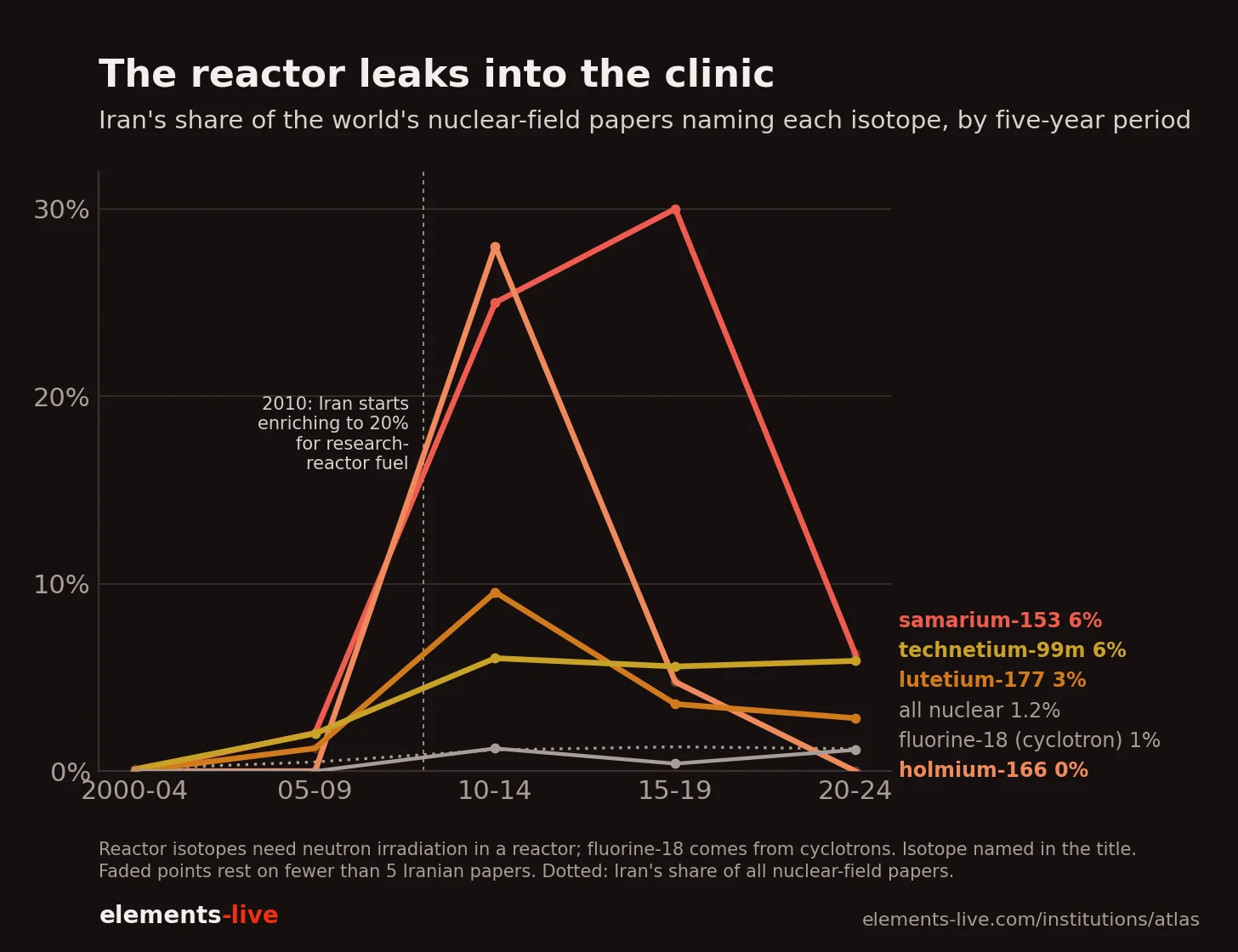
Nobody would call a bone-pain drug or a liver scan a weapons clue, but the isotopes inside them are fingerprints of a working reactor and its fuel, left in the most innocent papers there are. None of this settles whether the clinic is a cover for the bomb or a place its people went instead. What tips the balance comes from outside the papers. In bargaining theory, costly action reveals what an actor believes, because states don't pay a high price on information they don't trust. The escalation of the last five years, sabotage, targeted killings and finally direct strikes, has been very costly for those who chose it. It suggests that governments with far better information than ours saw the underlying work growing too, and the IAEA's public reports of enrichment to 60% point the same way. Costly action has rested on wrong intelligence before, as the Iraq war showed in 2003. This is an inference rather than proof, but it makes the gauge's rise harder to read as a quiet move into medicine alone.
Why this year
The same theory has something to say about timing, that war becomes more likely when one side comes to expect it to be cheap, and the timing of the war that began on 28 February fits that reading uncomfortably well. Eight weeks earlier, on 3 January, American forces had captured Venezuela's president in a raid on Caracas without losing a single soldier. Through January Iran's government had met nationwide protests with the deadliest crackdown in its history, killing thousands of protesters, many of them students, by the count of human-rights monitors. One event made a short, decisive operation look possible and the other made the Iranian state look weaker than it had in decades, and together they may have lowered the price of war in the minds of those deciding on it. That is a reading, not a finding, but it is a reminder that history, like technology, is path dependent, and that the moment a clue is read can matter as much as the clue.
No Conviction
None of this is a detector, a way to spot bombs from a library, and no court would convict on it. The gauge is wrong one time in ten about countries with no programme, it misses some programmes entirely, it rests on a few dozen papers a year in most of the countries that matter, and when a programme goes silent it can say only that something has gone quiet, not what. What it offers is what the searchers in the Atlantic were given, a map of where to look harder, built from clues each too weak to rely on alone and weighed honestly, including the places the instrument can't see.
Nothing in the method is specific to the bomb. Any technology a state tries to keep behind closed doors, from chemical and biological weapons to missile guidance, hypersonics or the most advanced chips, needs people trained in open fields and rests on science it can't classify, so it should leave the same glow and the same silences. The same search, priced as honestly, could be pointed at any of them, and at whatever comes after them. If someone is building a warp drive or a photon torpedo, its glow may already be in the papers.
As for Iran, its papers say that its nuclear science fell after the sabotage and killings of 2010–12, held level while the deal held, bottomed out in 2020 and has grown fast since 2021, back to the level of 2011, that most of the growth is in nuclear medicine and the other fields around the programme rather than in the agency that runs it, and that the core of the work is not in the journals. Whether that is a programme expanding or its people moving into medicine is exactly the question that the papers alone can't settle, and that the costliest decisions of the last five years suggest others have already answered. Nor is there yet any settled entry in the history books on why the deal came apart or who bears the blame for what followed, and there won't be for years. Every closed case in this story was closed by a confession that came long after the fact, South Africa's in 1993, Romania's in 1992, the Manhattan Project's in the archives opened after the war. Until Iran's files open, everyone reading these clues is in the position Flerov was in in 1942, looking at a silence and a few traces and having to decide what they mean. That is the curse of living through history rather than reading it. The suspect hasn't confessed, and in this kind of case it never will.
Methodology
Papers are the materials and chemistry papers in our records (from OpenAlex and related sources), credited fractionally to each institution's present-day country. Research communities are groups of papers that cite one another, found by community detection on the citation network. The nuclear groups are a fixed list of fifteen communities, chosen by reading their papers' titles, starting from the topics the Atomic Energy Organization of Iran itself publishes in, and frozen before the test was run: ten in the fuel cycle, reactors and fusion, three in radiation shielding and dosimetry, and two in nuclear medicine. The gauge is a country's share of the world's papers in those communities divided by its share of all papers, in five-year periods for the test set and three-year means for Iran. Periods with fewer than ten nuclear papers are shown faded and left out of the hit rates. Programme years are approximate and taken from the public record. Institutions are OpenAlex roots: the Atomic Energy Organization of Iran (including its Nuclear Science and Technology Research Institute), Malek Ashtar University of Technology and Imam Hossein University.
Now What?
The atlas shows every country and institution here year by year.
If you worked on safeguards, nonproliferation or in any of these programmes and the readings don't match what you know, tell me where. Those comments make the next version better.
Views are my own.